
For many followers of Ananda Marga around the world, an important and deeply The Disappearance of AMPS Registered Documents: A Public Interest Matter With National Importance
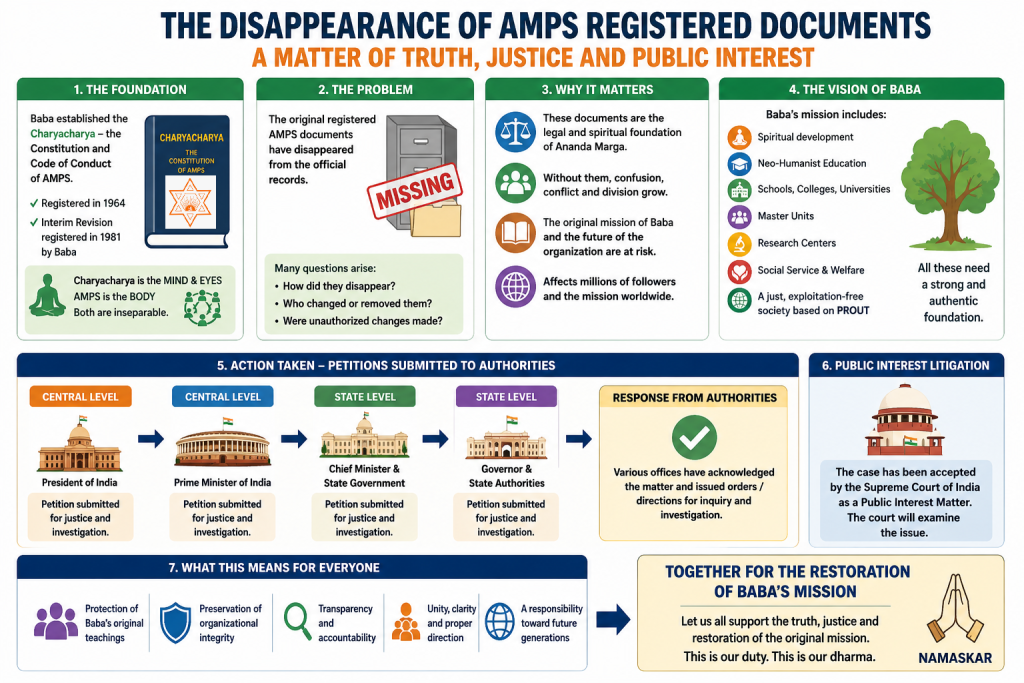
For many followers of Ananda Marga around the world, a deeply serious issue has emerged concerning the disappearance of the original registered documents of AMPS (Ananda Marga Pracaraka Samgha).
This issue is no longer viewed merely as an internal organizational dispute. It has now reached the level of a recognized public interest matter involving multiple levels of government and the Indian judicial system.
At the center of the concern are the original registered constitutional documents established under the authority of Prabhat Ranjan Sarkar, also known as Shrii Shrii Anandamurti or Baba.
The Importance of Charyacharya and AMPS
The foundational constitution and code of conduct of AMPS is known as Charyacharya.
The original version was legally registered in 1964, and an interim revision authorized directly by Baba was registered in 1981. According to many margiis and researchers, Baba did not authorize further revisions after that period.
For followers of Ananda Marga, these registered documents are considered essential because they define:
- the spiritual principles,
- organizational structure,
- ethical standards,
- social philosophy,
- and operational framework of the mission.
Many describe the relationship between Charyacharya and AMPS as similar to the relationship between a mind and a body:
- Charyacharya provides the guiding vision and principles,
- while AMPS provides the institutional structure through which those principles are implemented.
Concerns About Missing Original Records
Over time, questions arose regarding the status and availability of the original registered AMPS records.
During efforts to study and verify foundational legal documents connected to ongoing disputes within the organization, concerned researchers reportedly approached the registrar’s office seeking certified copies.
According to written responses referenced by investigators, the original AMPS registration file was reported as missing or unavailable.
This discovery created major concern because the documents are viewed as the legal and historical foundation of the organization.
The disappearance of foundational records naturally raised serious public questions:
- How did the original documents disappear?
- Who was responsible for preserving them?
- Were unauthorized alterations later introduced?
- How can authenticity now be independently verified?
The Matter Reached Multiple Levels of Government
The issue did not remain confined to private discussion.
Petitions and formal applications requesting investigation and justice were reportedly submitted to authorities across multiple levels of government in India, including:
- the Office of the President,
- the Prime Minister’s Office,
- state government authorities,
- governors,
- and other administrative institutions.
According to reports from those involved in the effort, various offices acknowledged the seriousness of the matter and issued directions or orders supporting inquiry and investigation into the issue.
As a result, the case evolved beyond an internal dispute and became recognized as a matter of broader public concern.
Acceptance of the Case as a Public Interest Matter
The issue eventually reached the Supreme Court of India through a Public Interest Litigation (PIL).
Importantly, the petition was accepted for consideration by the Court, meaning the matter was recognized as significant enough to merit judicial attention in the public interest.
For many observers, this represents a critical development because it acknowledges that the disappearance of foundational registered documents connected to a major international socio-spiritual organization may carry wider legal, ethical, and institutional implications.
The matter is therefore no longer seen only as an internal organizational disagreement, but as a question involving:
- preservation of registered historical records,
- institutional accountability,
- transparency,
- legal continuity,
- and protection of constitutional documentation.
A Question of Authenticity and Future Direction
Many margiis believe the issue ultimately concerns the preservation of Baba’s original mission and vision.
That vision included not only spiritual practice, but also:
- Neo-Humanist education,
- social service,
- Master Units,
- schools and universities,
- research centers,
- welfare programs,
- and the development of a just and exploitation-free society guided by PROUT principles.
Supporters argue that such long-term social and spiritual goals require a transparent and authentic constitutional foundation.
Without clarity regarding the original registered documents, confusion and fragmentation can continue to grow.
Why This Matters Beyond Ananda Marga
The issue also reflects a larger question relevant to many organizations worldwide:
What happens when foundational records of an important institution disappear?
Whether religious, educational, charitable, or social, institutions depend on historical continuity, documented legitimacy, and public trust.
For this reason, many believe that investigating the disappearance of the original AMPS records is not only important for margiis, but also important as a matter of institutional integrity and public accountability.
For supporters of the restoration effort, protecting the original mission established by Baba is viewed as both a moral duty and a responsibility toward future generations.
Namaskar.